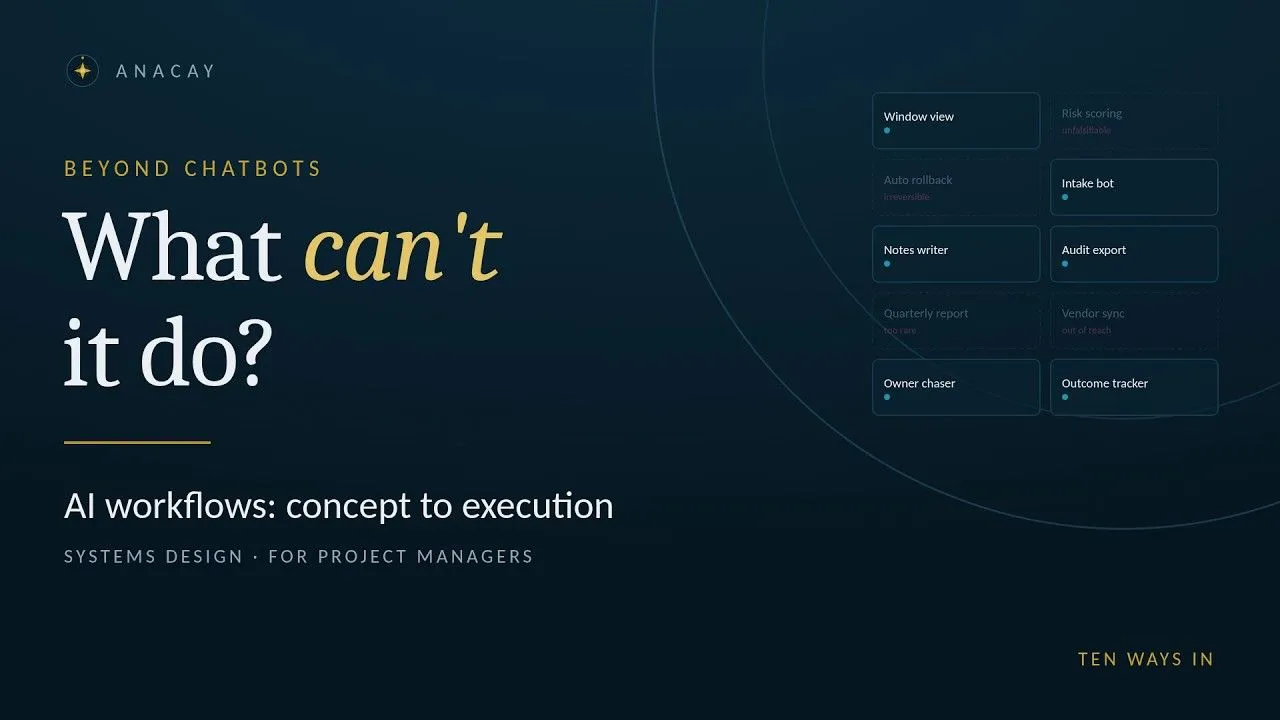
AI Workflows: From Concept to Execution (for Project Managers)
Randy has three things to do by the end of the quarter. Put every change going into a release window in front of the people who approve it, before that window opens. Track what actually shipped. Publish the release notes on Friday.
He has done work like this before, with none of the tools used here. He is not guessing. What he has not done is build it himself, and the limits of the toolbox are not where his instincts say they are. So he goes and finds them — by reading what each tool refuses to do, and by cheaply testing the one thing the documentation will not say.
Session two of Beyond Chatbots, a series for project managers. This one is about design: the afternoon that saves the quarter, and almost nobody gives it an afternoon.
Session one — Ready to Launch: From Prompt to Workflow: https://youtu.be/bxtKZzHJPTU
What you get
- One sentence pulled apart into five jobs, and the one of them that still needs a person
- Four of ten approaches ruled out on paper, and the four questions that did it — frequency, checkable judgment, reversibility, reachable evidence
- A data store chosen by reading what it refuses to do, not what it promises
- The difference between a knowledge source and a tool, which decides whether your design survives contact
- A run limit that ends a flow at thirty days, found on paper instead of in production
- What to do when the documentation stops: test it, as cheaply as you can make the test
- A prototype that answers one question, a pilot that changes the design, and the difference between them
- Idempotency, a gate with a deliberate hole in it, and why collisions cost you attribution rather than a release
- What the whole thing costs to run, which is nothing, and exactly where that stops being true
Sources, checked 6–7 October 2026
- Güven & Murthy, CNSM 2016 — 86% of incidents caused by change come from a change that closed successfully
- Google SRE — roughly 70% of outages follow a change to a live system; one canary at a time
- DORA 2025 — about 38% of respondents report a change failure rate above 16%
- ITIL 4 — change authority, standard change
- Microsoft Learn — Excel Online connector limits, SharePoint list limits, agent builder actions, approvals and the thirty-day run limit, environment creation, Power Automate and Copilot Studio pricing
A note on prices and limits: every figure on screen carries the date it was checked. Vendor pages move, and the page that priced this episode says in its own words that its prices are for marketing purposes and may not reflect actual list price. Check before you quote any of it to someone who controls a budget.
Captions are included and were built from a word-level alignment of the final audio, not auto-generated.
Anacay — anacay.com