AI Workflow Design for Project Managers
Nora fills in the same form every week. Forty fields, out of a vendor document that is half form and half paragraph, and the answers to a good number of those fields are buried in the prose rather than the boxes.
She drives it with one chat assistant and a file of rules she keeps adding to, about sixty lines now, each one added on a Tuesday because something broke on a Monday. It works. Most of the time. Then she is out for a week, a colleague runs the same prompt against the same document, and the answers come back different — and she cannot read her own file and say why.
That is not a prompt that needs better wording. It is a prompt that was never designed.
Session three of Beyond Chatbots, a series for project managers. Everything here runs on one chat assistant with no agents, no scripts and no new licence, and the session says so out loud at the start so nothing later is a bait-and-switch.
Session one — Are We Ready? Building an AI Launch Go/No-Go Workflow:
Session two — AI Workflows: From Concept to Execution:
What you get
- Why a rules file fights itself: the rules are global, the defects are local, so every fix quietly degrades a field it was never written for
- The two rules that cannot both be satisfied — "be concise" and "always fill every field" — and why no rewording resolves it
- Decide the shape before the wording: a target that needs three rows and a prompt that writes prose will never agree, however many rules you stack on it
- The four classes every target field falls into — Move, Interpret, Look up, Consequence — and the twenty minutes with a pen that sorts them
- The class everybody drops, and the day on site it costs
- The most valuable move available: reclassifying a field downward, out of the class where answers can be confidently wrong
- What a tool connector is actually for, in three distinct jobs, including the one that catches a disagreement nobody could see before
- An output that carries how every value got there — derived from evidence, not from a confidence score the model invents about itself
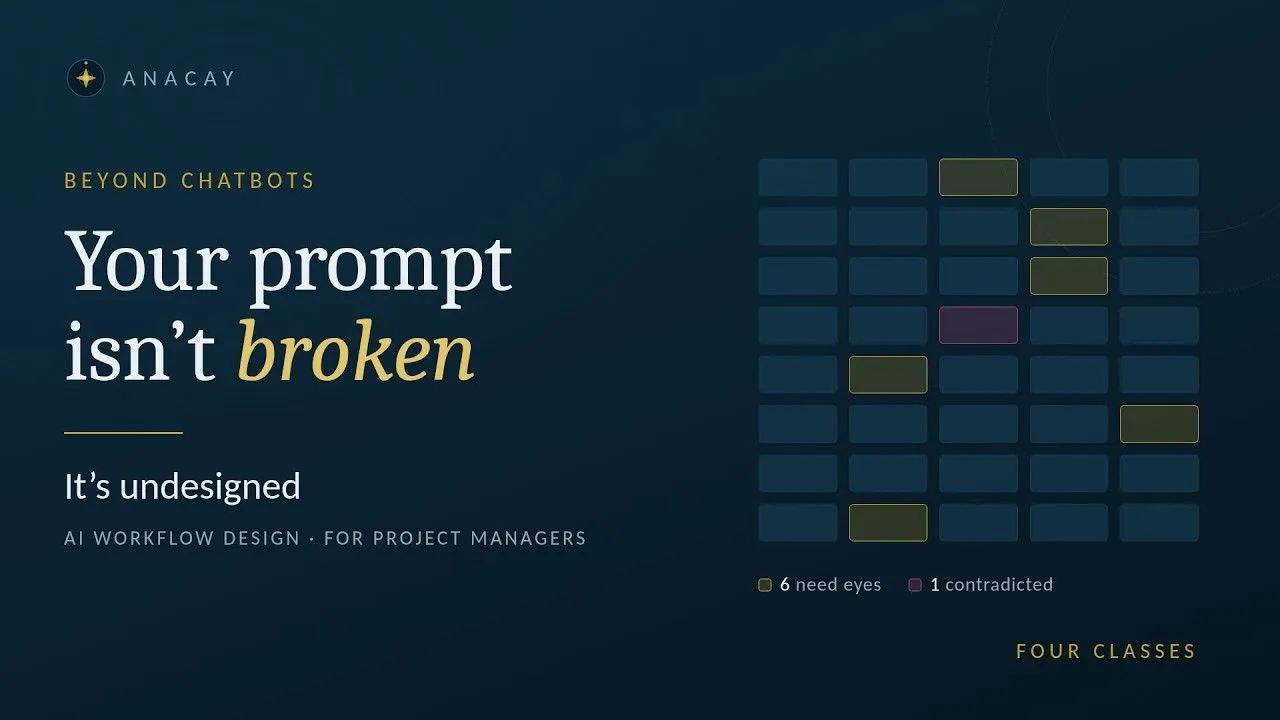
- Forty fields, six need eyes, one contradicted: review effort that is countable, and a business case that fits on one line
- Why the design that makes it reliable is the same design that makes it cheap
- The handover test that decides whether you built a skill or an asset
A note on the case: it is a constructed example, built to carry the three things a real one has to contain — an absence, a conflict and an inference. The method is the deliverable, not the scenario.
A note on tools: the session names ChatGPT, Copilot and Gemini only to translate the same idea across them. Delete every product name and the argument is unchanged, which is the point. Check any product detail before you quote it to someone who controls a budget.
Captions are included and were built from a word-level alignment of the final audio, not auto-generated.
Anacay — anacay.com